
Key points
- An ECG records the heart’s electrical activity and can show rate, rhythm, and conduction patterns.
- It is commonly used for symptoms such as chest pain, palpitations, dizziness, fainting, and shortness of breath.
- An ECG may suggest arrhythmias, reduced blood flow, past heart damage, or some electrolyte disturbances.
- A normal ECG does not rule out intermittent rhythm problems or all forms of heart disease.
- Further tests may still be needed to assess heart structure, valve function, or symptoms not captured on the tracing.
An electrocardiogram, usually called an ECG or EKG, is a quick test that records the heart’s electrical activity. It can help show whether the heart is beating too fast, too slowly, irregularly, or under strain. It is commonly used when a doctor wants to investigate symptoms such as chest pain, palpitations, dizziness, fainting, or shortness of breath. For a general overview of common diagnostic procedures, see Examinations and Treatments Explained for Patients.
For many patients, the main questions are simple: what does an ECG actually show, when is it used, and what can it miss? This article explains what the test measures, why doctors order it, what the results may indicate about heart rhythm and heart function, and the important limits of a standard ECG.
What an ECG measures in heart activity
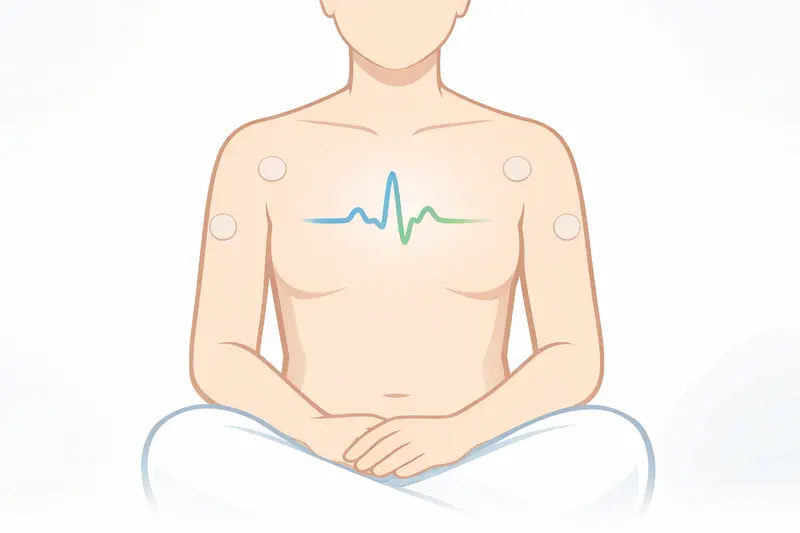
An ECG records the electrical signals that pass through the heart each time it beats. Sticky electrodes are placed on the skin, usually on the chest, arms, and legs. These electrodes do not send electricity into the body. They detect the heart’s own electrical activity and display it as a tracing.
Each part of the tracing reflects a different stage of the heartbeat. In simple terms, an ECG can show:
- how fast the heart is beating
- whether the rhythm is regular or irregular
- how electrical signals travel through the atria and ventricles
- whether there are signs that the heart muscle is under stress or has been damaged
- whether there may be enlargement of parts of the heart in some cases
What the ECG tracing represents
The tracing is made up of waves and intervals. Doctors look at the overall pattern rather than a single number. For example:
- the P wave reflects electrical activation of the atria
- the QRS complex reflects electrical activation of the ventricles
- the T wave reflects recovery of the ventricles after each beat
Changes in these parts of the tracing can suggest rhythm problems, conduction delays, electrolyte disturbances, or reduced blood flow to the heart muscle. Interpretation always depends on the clinical situation, age, symptoms, medicines, and whether older ECGs are available for comparison.
What the test is like for the patient
A standard resting ECG is painless and usually takes only a few minutes. The patient lies still while the recording is made. It does not require needles, sedation, or recovery time. In some situations, the skin may be cleaned or small areas of hair may be removed so the electrodes stick properly.
When doctors recommend an ECG test
A doctor may recommend an ECG when there are symptoms that could be related to the heart, when there is a known heart condition to monitor, or before certain treatments or procedures. The reason for the test helps determine how useful it is and whether further testing may also be needed.
Common symptoms that may lead to an ECG
An ECG is often used as an early test if a person has symptoms such as:
- chest pain or chest tightness
- palpitations, including a fluttering, pounding, or racing heartbeat
- dizziness or light-headedness
- fainting or near-fainting
- shortness of breath
- unexplained fatigue, especially if it is sudden or associated with exertion
For example, if someone has sudden chest pain, an ECG may help show whether there are signs of reduced blood flow to the heart muscle. If someone reports brief episodes of a racing heartbeat, it may show an arrhythmia if that rhythm is happening during the recording.
Monitoring known or suspected heart problems
An ECG may also be used in people with known cardiovascular disease or when a doctor suspects a structural or electrical problem. Examples include:
- known arrhythmias such as atrial fibrillation
- previous heart attack
- angina or suspected coronary artery disease
- heart failure
- pacemaker checks, depending on the situation
- follow-up after certain cardiac procedures
Before medicines, surgery, or other treatment
Some medicines can affect heart rhythm or electrical conduction, so an ECG may be done before starting them or during follow-up. This is particularly relevant for some antiarrhythmic drugs, certain psychiatric medicines, and some treatments that can prolong the QT interval. If you’re wondering what is typically checked in a general screening, our detailed breakdown of what is included in a routine health checkup may provide additional practical context.
An ECG may also be requested before surgery or during an emergency assessment if there is concern about cardiovascular risk, although the need depends on the person’s age, symptoms, medical history, and the type of procedure planned.
What ECG results can indicate about heart rhythm
One of the main uses of an ECG is to assess heart rhythm. It can show whether the heartbeat starts in the heart’s normal pacemaker area and whether the electrical signal is travelling normally through the conduction system.
Rhythm abnormalities an ECG may show
A standard ECG can identify many rhythm problems, including:
- atrial fibrillation, where the rhythm is irregular and often fast
- atrial flutter, a more organized but abnormal atrial rhythm
- supraventricular tachycardia, a fast rhythm starting above the ventricles
- bradycardia, where the heart rate is slower than expected
- ventricular tachycardia, a potentially serious fast rhythm from the ventricles
- extra beats, such as premature atrial or ventricular contractions
It can also show conduction problems, such as atrioventricular block or bundle branch block. These findings may help explain symptoms such as fainting, weakness, or palpitations.
Other clues an ECG can provide
Although rhythm is a major focus, ECG findings may also suggest:
- possible reduced blood flow to the heart muscle
- evidence of a current or previous heart attack
- effects of low or high potassium and some other electrolyte disturbances
- inflammation around the heart in some cases, such as pericarditis
- effects of certain medicines or toxic exposures
However, an ECG result is rarely interpreted in isolation. A doctor usually considers symptoms, examination findings, blood tests, imaging, and previous ECGs. A mildly abnormal tracing may be clinically unimportant in one person but significant in another.
Why a normal ECG does not always rule out a rhythm problem
Many rhythm problems come and go. If the abnormal rhythm is not happening during the short recording, the ECG may appear normal. This is one reason some patients need longer monitoring, such as a 24-hour Holter monitor, an event recorder, or a wearable rhythm device.
What an ECG cannot detect
An ECG is useful, but it does not provide a complete picture of heart health. It records electrical patterns, not a full view of heart structure, blood flow, or valve function. A normal ECG does not automatically mean the heart is normal in every way.
Problems that may need other tests
An ECG may miss or only weakly suggest conditions such as:
- intermittent arrhythmias that are not present during the test
- early coronary artery disease without ECG changes at rest
- valve disease such as aortic stenosis or mitral regurgitation
- heart muscle weakness or pumping problems, which are better assessed with echocardiography
- structural abnormalities such as some congenital heart defects
For example, a person may have chest discomfort from coronary artery disease but still have a normal resting ECG, especially between episodes. In that situation, a stress test, blood tests, coronary CT, or another cardiac evaluation may be more informative.
It cannot measure everything about the heart
An ECG does not directly show:
- how well the heart pumps blood
- how narrowed the coronary arteries are
- whether a heart valve opens and closes properly
- the exact cause of chest pain, breathlessness, or collapse
That is why an ECG is often one part of a wider assessment rather than a final answer on its own.
Limitations of ECG tests
The main limitation of a standard ECG is that it captures only a short moment in time. This is very useful for ongoing abnormalities, but much less reliable for symptoms that occur only occasionally.
Important practical limitations
- A normal ECG does not exclude serious disease. Some heart conditions produce no clear changes on a resting tracing.
- Abnormal findings are not always specific. The same ECG change may have several possible explanations.
- Results can be influenced by technical factors. Electrode placement, movement, poor skin contact, or electrical interference can affect the tracing.
- Some changes are age-related or harmless variants. Not every abnormal-looking result means disease.
When more testing may be needed
If symptoms continue despite a normal ECG, or if the result raises further questions, a doctor may recommend additional tests such as:
- ambulatory ECG monitoring, such as Holter monitoring
- exercise ECG or stress testing
- echocardiography
- blood tests, including cardiac markers in urgent situations
- cardiac CT or other imaging, depending on the suspected problem
In practical terms, an ECG is best understood as a fast and valuable first-line test. It can reveal important clues about heart rhythm and possible cardiac stress, but its usefulness depends on timing, symptoms, and the wider clinical context.


