
Key points
- Ultrasound is often a first-line imaging test for soft tissues, fluid, blood flow, and pregnancy.
- It can help detect findings such as gallstones, cysts, fibroids, blood clots, and some soft tissue lumps.
- Results may be normal, clearly benign, or show abnormalities that need follow-up or further testing.
- Ultrasound has limits and may miss problems hidden by bone, gas, depth, or very small size.
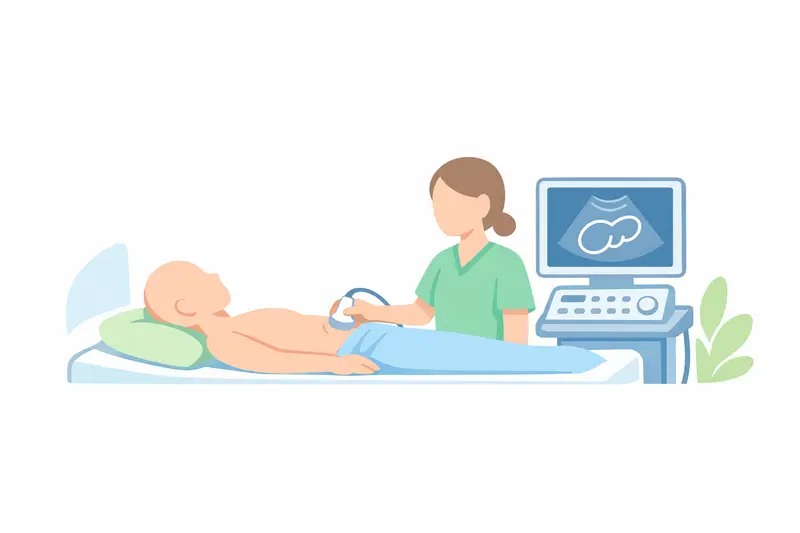
Ultrasound is a common imaging test that uses high-frequency sound waves to create real-time images from inside the body. For more information on how different examinations and treatments work together in patient care, see Examinations and Treatments Explained for Patients. It is often used because it does not involve ionising radiation, can show movement such as blood flow or a baby’s heartbeat, and is well suited to examining soft tissues and fluid-filled structures.
For patients, the main questions are usually practical ones: what an ultrasound can show, when it is useful, what the results may mean, and where its limits lie. The sections below explain these points clearly, including when ultrasound is often the first choice and when another scan may be needed.
What an ultrasound examination can detect
Ultrasound can detect many changes in organs, blood vessels, soft tissues, and a developing pregnancy. It works especially well when doctors need to see the size, shape, position, or movement of a structure in real time.
Common findings in the abdomen and pelvis
An abdominal or pelvic ultrasound may help detect:
- Gallstones and signs of gallbladder inflammation
- Liver changes such as fatty liver, cysts, some tumours, or enlargement
- Kidney stones in some cases, swelling of the kidney caused by blocked urine flow, or kidney cysts
- Fluid in the abdomen
- Ovarian cysts, uterine fibroids, or thickening of the womb lining
- Enlargement of the prostate or problems with bladder emptying
Pregnancy and gynaecology
In pregnancy, ultrasound is used to confirm the location and development of a pregnancy, estimate gestational age, assess the placenta, and check fetal growth and anatomy. In early pregnancy, it may also help clarify the cause of bleeding or pain, including whether a pregnancy is inside the uterus.
In gynaecology, transabdominal or transvaginal ultrasound may help show ovarian cysts, fibroids, signs of torsion, or features that need further assessment.
Blood flow, heart, muscles, and superficial structures
Doppler ultrasound can show blood flow in arteries and veins. This may help detect problems such as deep vein thrombosis, narrowed arteries, varicose vein-related changes, or reduced blood supply to an organ.
Ultrasound is also used for:
- Thyroid nodules and thyroid enlargement
- Breast lumps, especially to distinguish solid lesions from fluid-filled ones
- Testicular pain, swelling, or suspected torsion
- Soft tissue lumps such as cysts, lipomas, or abscesses
- Tendon tears, joint fluid, and some muscle injuries
- The heart, through echocardiography, to assess valve movement, pumping function, and fluid around the heart
What ultrasound can detect depends greatly on the part of the body being examined, the reason for the test, the patient’s body habitus, and the skill of the operator.
When doctors recommend an ultrasound examination
Doctors often recommend ultrasound when they need a quick, non-invasive first look at a specific symptom or area of concern. It is widely used because it is accessible, does not usually require recovery time, and can often be performed without contrast agents or sedation.
Typical reasons for referral
An ultrasound examination may be recommended for symptoms or situations such as:
- Upper abdominal pain, especially if gallstones are suspected
- Pelvic pain, abnormal uterine bleeding, or a suspected ovarian cyst
- Pregnancy dating, routine fetal assessment, or pregnancy-related pain or bleeding
- A palpable lump in the neck, breast, groin, or soft tissues
- Leg swelling or pain when a blood clot needs to be ruled out
- Abnormal liver, kidney, thyroid, or pelvic examination findings
- Difficulty passing urine or suspected urinary retention
- Scrotal pain or swelling
Why ultrasound is often chosen first
Ultrasound is often the first imaging test when the question is focused and relates to soft tissue, fluid, blood flow, or pregnancy. It can be used at the bedside, repeated if needed, and may guide procedures such as draining fluid, taking a biopsy, or placing a needle accurately.
In emergency settings, ultrasound may help assess internal bleeding, gallbladder inflammation, urinary obstruction, or problems in early pregnancy. In outpatient care, it is commonly used to clarify symptoms before deciding whether further tests such as CT, MRI, mammography, or endoscopy are needed. For more details on medical imaging safety and potential risks, see our related guidance.
What ultrasound results can indicate
Ultrasound results may show that the examined area looks normal, that there is a clearly benign finding, or that there is an abnormality that needs monitoring, further imaging, or referral to a specialist. The result does not usually stand alone; it is interpreted together with symptoms, examination findings, and sometimes blood tests.
Examples of what findings may suggest
- A simple fluid-filled cyst may suggest a benign change that often only needs observation
- Gallstones with a thickened gallbladder wall and tenderness may suggest cholecystitis
- A widened kidney drainage system may indicate obstruction, for example from a stone
- Absence of normal blood flow in a vein may suggest deep vein thrombosis
- A solid mass may indicate a lesion that needs further characterisation with additional imaging or biopsy
- In pregnancy, differences between expected and measured growth may suggest the need for closer monitoring
Normal does not always mean no problem
A normal ultrasound can be reassuring, but it does not rule out every cause of symptoms. For example, bowel conditions, small stones, early inflammation, or some cancers may not be clearly visible. If symptoms continue, a doctor may still recommend repeat imaging, a different scan, or another type of investigation.
The wording of the report also matters. Terms such as simple cyst, solid lesion, increased blood flow, fatty infiltration, indeterminate finding each carry different levels of concern and may lead to different next steps.
What an ultrasound cannot detect
Ultrasound cannot show everything equally well. It is less reliable for structures hidden behind bone or gas, and it may miss abnormalities that are very small, deep, or difficult to distinguish from surrounding tissue.
Areas ultrasound is not good at imaging
- The lungs in detail, because air interferes with sound waves
- Most of the brain in adults, because the skull blocks the ultrasound beam
- Deep bowel structures when there is significant intestinal gas
- Some parts of the pancreas, especially if overlying bowel gas obscures the view
- Very small lesions that fall below the resolution of the scan
Conditions that may need other tests
Ultrasound may not be enough if the clinical question involves:
- Detailed cancer staging
- Complex internal injuries after major trauma
- Subtle brain disorders or spinal problems
- Many causes of chronic abdominal pain related to the bowel
- Small fractures or joint cartilage injuries
In these situations, CT, MRI, X-ray, endoscopy, or laboratory testing may provide more useful information. Ultrasound can still play a role, but not always as the main test.
Limitations of ultrasound examinations
The main limitations of ultrasound are technical and anatomical. The quality of the examination can vary more than with some other imaging methods, and the result depends on which part of the body is being assessed.
Factors that can reduce image quality
- Excess bowel gas, which blocks the sound waves
- Obesity, which can make deep structures harder to visualise clearly
- Very small or early abnormalities that do not yet change the appearance enough to be detected
- Patient movement or difficulty holding the required position
- Anatomical location, especially if the target lies behind bone or deep in the body
Operator dependence and follow-up testing
Ultrasound is operator-dependent, meaning the quality of the examination is influenced by the experience of the person performing it and by how well the test is targeted to the clinical question. A technically limited scan does not necessarily mean that anything serious is present, but it may mean the doctor cannot answer the original question with enough confidence.
For that reason, patients are sometimes told that the ultrasound was inconclusive. This may lead to repeat ultrasound, specialist ultrasound, MRI, CT, or another test better suited to the body area or suspected condition.
In practice, ultrasound is most useful when its strengths match the medical question. It is excellent in many common situations, but like every imaging method, it has limits that affect what it can and cannot show.


