
At a glance
- You will usually be asked to remove your wedding ring before an MRI scan.
- Metal objects can affect both MRI safety and image quality, even if the ring seems small or harmless.
- Do not assume your ring is safe just because it is gold, silver, or non-magnetic.
- If you cannot remove it, tell the MRI staff before the scan begins.
Short answer
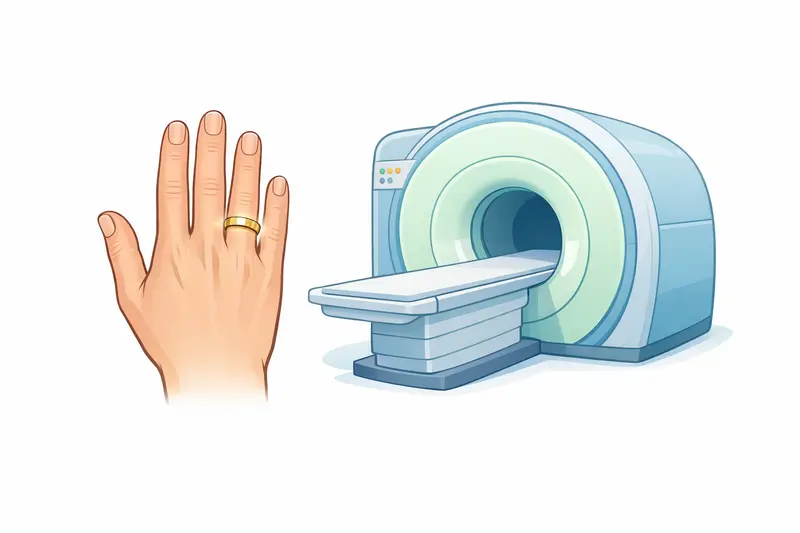
In most cases, no, you should not wear your wedding ring during an MRI scan. MRI machines use a very strong magnetic field, and metal items can sometimes move, heat up, or interfere with the images. Even rings that are not strongly magnetic may still need to be removed. If your ring is stuck or cannot be taken off safely, tell the MRI team straight away so they can decide the safest next step.
What to know
Why rings are usually removed
An MRI scanner differs from an X-ray or CT scanner because it uses a powerful magnet. Metal jewellery, including wedding rings, can create a safety risk or distort the images. This is especially relevant if the scan is of your hand, wrist, arm, chest, or nearby areas.
What if the ring is gold or non-magnetic?
Some people assume a gold or platinum wedding band is always safe in an MRI, but that is not something to rely on. Rings may contain mixed metals, and even non-magnetic metal can still affect image quality or become uncomfortable if it warms up. MRI staff will usually follow a standard safety policy and ask for all jewellery to be removed.
If your ring is stuck
Do not force it if your finger is swollen or painful. Before your appointment, you can try removing it gently with soap, hand lotion, or after raising your hand for a few minutes to reduce swelling. If it still will not come off, tell the imaging centre before the scan. They may reschedule the appointment, suggest safe removal options, or assess whether the scan can go ahead.
What to do before the appointment
If possible, leave jewellery at home. If you wear your ring every day, allow a few extra minutes before you leave for your appointment so you can remove it without rushing. Also mention any other metal items, such as hearing aids, piercings, watches, insulin pumps, or implanted devices, because these are often more important for MRI safety than a ring.
When to seek medical advice
- Your finger is swollen, blue, numb, or very painful and the ring will not come off.
- You have a wound, infection, or recent injury under or around the ring.
- You are unsure whether you have any implanted metal or medical device that could affect MRI safety.
- You felt heat, pain, pulling, or discomfort from metal during a previous MRI.
Continue reading
For more on what happens before, during, and after this scan, read our broader article on what to expect from an MRI scan. You can also explore our main Examinations and Treatments Explained for Patients hub for plain-language guides to common tests, scans, and procedures.
Sources
NHS: MRI scan | RadiologyInfo: MR Safety | U.S. FDA: MRI (Magnetic Resonance Imaging)


