
Key points
- MRI uses magnets and radio waves to produce detailed images without using X-rays.
- It is especially useful for assessing soft tissues such as the brain, spine, joints, muscles, and internal organs.
- Preparation mainly involves safety checks for metal implants, devices, and other metallic objects.
- The scan is usually painless, but it can feel noisy and enclosed, and staying still is important.
- MRI is generally safe, but some implants, contrast use, and claustrophobia may affect whether or how it is done.
An MRI scan is a diagnostic imaging test that uses a strong magnetic field and radio waves to create detailed images of structures inside the body. It does not use X-rays and is often chosen when doctors need a closer look at soft tissues such as the brain, spine, joints, muscles, nerves, or internal organs. For a broader overview of medical imaging and procedures, see Examinations and Treatments Explained for Patients.
For many patients, the main questions are practical: why an MRI has been recommended, how to prepare, what happens inside the scanner, and whether there are any risks. The sections below explain what an MRI scan can show, how the test is performed, and what to expect before, during, and after the appointment.
What an MRI scan shows and how it works
MRI stands for magnetic resonance imaging. The scanner uses a powerful magnet and radiofrequency pulses to produce highly detailed images of the body. A computer then converts the signals from the body into cross-sectional images that doctors can review from different angles.
One of the main strengths of MRI is that it shows soft tissues more clearly than many other imaging tests. This makes it useful for areas where detail matters, such as the brain, spinal cord, ligaments, cartilage, pelvic organs, liver, and blood vessels.
An MRI scan may help show:
- brain changes such as stroke, inflammation, tumours, or signs of multiple sclerosis
- spinal problems including disc prolapse, nerve compression, or spinal cord abnormalities
- joint and sports injuries affecting cartilage, ligaments, tendons, or menisci
- muscle or soft tissue abnormalities
- problems in organs such as the liver, uterus, prostate, or kidneys
- some blood vessel abnormalities, sometimes with a special MRI technique called MR angiography
In some MRI scans, a contrast agent is used to make certain tissues or blood vessels easier to assess. This is usually given through a vein in the arm. Contrast is not needed for every MRI and depends on the part of the body being examined and the clinical question.
When doctors recommend an MRI scan
A doctor may recommend an MRI when symptoms, examination findings, or earlier test results suggest that more detailed imaging is needed. MRI is often used when the aim is to assess soft tissues rather than bones alone.
Common reasons for requesting an MRI include:
- persistent headaches with neurological symptoms
- back pain with suspected nerve involvement, such as pain radiating into an arm or leg
- joint pain after injury, especially if ligament or cartilage damage is suspected
- unexplained weakness, numbness, dizziness, or seizures
- follow-up of a known condition such as multiple sclerosis, a tumour, or inflammatory bowel-related complications
- assessment of pelvic pain, fibroids, endometriosis, prostate disease, or liver lesions
MRI is not always the first test. A doctor may choose an ultrasound, X-ray, or CT scan instead, depending on the symptoms and the body area involved. For example, an X-ray is often used first for a suspected fracture, while key differences between CT and MRI scans may be more helpful later if ligament, disc, or soft tissue injury is a concern.
The urgency also varies. Some MRI scans are arranged electively, while others are requested more quickly if there is concern about conditions such as spinal cord compression, stroke, or severe neurological change.
How to prepare for an MRI scan
Preparation for an MRI is usually simple, but it is important to follow the instructions from the imaging centre or hospital. The most important point is safety around metal, because the MRI scanner uses a very strong magnet.
Safety screening before the scan
Before the appointment, patients are normally asked about:
- pacemakers or implanted cardiac devices
- cochlear implants
- aneurysm clips or other metal clips
- metal fragments in the eye or body
- joint replacements, plates, screws, or surgical hardware
- insulin pumps or other electronic medical devices
- pregnancy
- kidney problems, especially if contrast may be used
Many implants are MRI-compatible, but this always needs to be checked. Patients should not assume an implant is safe without confirmation.
Clothing, jewellery, and personal items
Metal objects usually need to be removed before the scan. This may include jewellery, hairpins, hearing aids, glasses, watches, credit cards, phones, and clothing with metal fasteners. In some centres, patients change into a gown.
Cosmetics can also matter in some cases, especially if they contain metallic particles. Patients having a scan near the eyes or face may be asked to avoid certain make-up products.
Food, drink, and medicines
Many MRI scans do not require fasting. However, if contrast is planned, if the abdomen is being scanned, or if sedation is needed, different instructions may apply. Regular medicines can often be taken as usual unless specific advice has been given otherwise.
Patients who are prone to claustrophobia should mention this in advance. Depending on the situation, the referring doctor may discuss options such as mild sedation, or the imaging centre may offer practical support.
What happens during an MRI scan
At the appointment, a radiographer usually explains the process and checks the safety questionnaire. If contrast is needed, a small cannula may be placed in a vein before the scan starts.
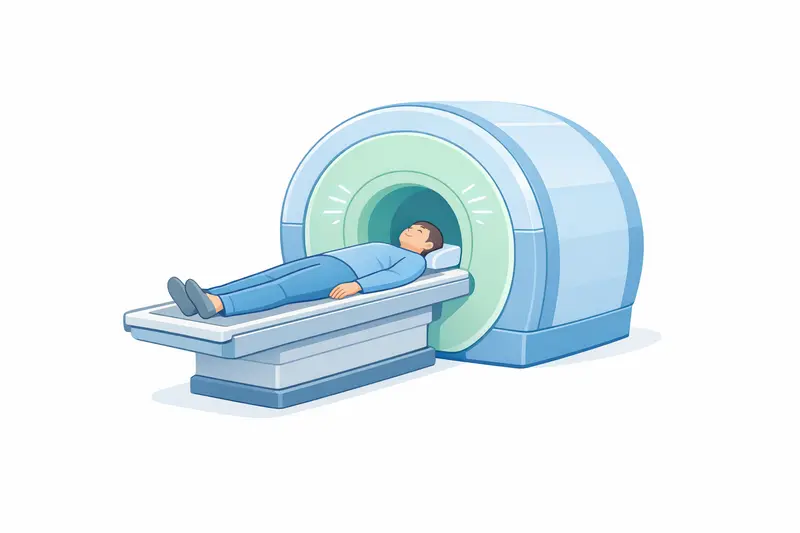
The patient then lies on a narrow examination table that slides into the scanner. The scanner is open at both ends, but it can still feel enclosed, especially during scans of the head, spine, or upper body.
During the scan:
- it is important to stay as still as possible so the images do not blur
- the machine makes loud tapping, thumping, or knocking sounds
- earplugs or headphones are usually provided
- the radiographer can see and hear the patient from the control room
- a call button is usually given so the patient can alert staff if needed
The scan may last around 15 to 60 minutes, depending on the body area and whether contrast images are needed. Some more complex studies can take longer.
An MRI scan itself should not be painful. The main difficulties are usually the noise, the need to lie still, and the enclosed space. Some patients feel warmth in the scanned area, which is often normal. If contrast is injected, there may be a brief cool sensation in the arm.
After the scan, most patients can return to normal activities straight away. If sedation was used, someone may need to accompany the patient home, and driving may not be allowed for the rest of the day, depending on the medication given.
Risks and limitations of MRI scans
MRI is generally considered a safe test for many patients, and it does not expose the body to ionising radiation. However, it is not suitable for everyone, and it also has some practical limitations.
Possible risks
The main safety concern relates to metal or electronic devices in or on the body. A strong magnetic field can interfere with some implants or move unsafe metallic objects. This is why screening questions are taken seriously.
If contrast is used, side effects are usually mild and uncommon, but they can include nausea, headache, or reactions at the injection site. Allergic-type reactions are possible, but less common than with some other contrast agents. In people with significantly reduced kidney function, contrast use may require extra caution.
Pregnancy does not always rule out MRI, but the decision depends on the clinical situation and stage of pregnancy. Contrast is used more selectively in pregnancy.
Limitations of MRI
An MRI scan does not answer every medical question. It may be less useful for some bone injuries, some emergency situations where speed is critical, or when a patient cannot stay still enough for clear images.
MRI findings also need to be interpreted in context. For example, a scan may show disc degeneration, small joint changes, or other abnormalities that are not necessarily the cause of symptoms. This is why scan results are assessed together with symptoms, examination findings, and other tests.
Some patients cannot complete an MRI because of severe claustrophobia, body size limitations, pain when lying flat, or the presence of a non-compatible implant. In those situations, a doctor may consider another imaging method or a different scanning setup where available.


