
Magnetic Resonance Imaging (MRI) scans are an important tool in modern medicine, helping doctors see inside the body without surgery or exposure to radiation. If your doctor has recommended an MRI, you might have questions about what will happen during the scan and how the results will be used. This article will guide you through the MRI process step-by-step and explain how doctors interpret and use the images to support your care.
Understanding what to expect can help reduce anxiety and ensure you are well-prepared for your appointment. Below, you will find clear answers to common questions about MRI scans, including why they are ordered, what happens before and during the scan, and how the results are used to make informed decisions about your health.
Why doctors order an MRI scan
Doctors order MRI scans for a variety of reasons. Unlike X-rays and CT scans, which use ionising radiation, MRI uses strong magnets and radio waves to create detailed images of organs, tissues, and bones. This makes MRI particularly useful for visualising soft tissues and areas that are difficult to assess with other imaging techniques.
- Diagnosing unexplained symptoms: If you have symptoms such as persistent headaches, joint pain, or unexplained swelling, an MRI can help identify the underlying cause.
- Evaluating injuries: MRIs are often used to assess injuries to the brain, spine, joints, or soft tissues, providing detailed images that guide treatment.
- Monitoring chronic conditions: For conditions like multiple sclerosis, cancer, or inflammatory diseases, MRI allows doctors to monitor changes over time.
- Planning for surgery or treatment: Detailed images help surgeons and other specialists plan procedures with greater accuracy, reducing risks and improving outcomes.
- Screening for certain diseases: In some cases, MRI is used to screen for tumors or other abnormalities, especially in patients at higher risk.
Your doctor will explain why an MRI has been recommended in your specific case. If you have questions or concerns, be sure to discuss them before your appointment.
What happens before and during the scan
An MRI scan involves several steps, from preparation to the actual imaging process. Knowing what to expect can make the experience more comfortable.
Before the scan
- Screening for safety: You will be asked about any metal implants, pacemakers, or medical devices, as these can interfere with the MRI’s magnetic field.
- Removing metal objects: You will need to remove jewellery, watches, hairpins, and other metal items before entering the scanning room.
- Changing clothes: In most cases, you will be given a hospital gown to wear during the procedure.
- Answering questions: The radiology team may ask about your medical history, allergies, and prior surgeries to ensure your safety.
- Contrast agents: Sometimes, a special dye (contrast agent) is injected to enhance image quality. If this is needed, you will be informed in advance.
During the scan
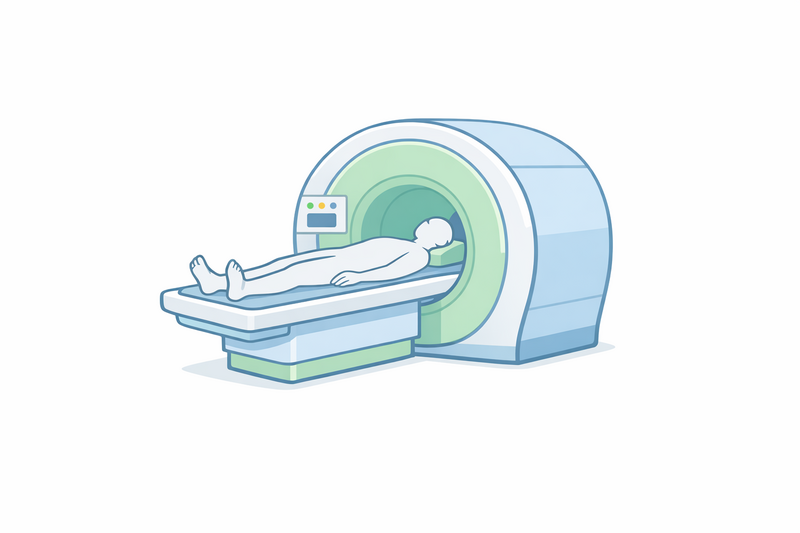
- Positioning: You will lie down on a narrow table that slides into the MRI scanner, which looks like a large tunnel or tube.
- Staying still: It is important to remain as still as possible during the scan, as movement can blur the images.
- No pain: The scan itself is painless, though you may feel some discomfort from lying still or from the sounds produced by the machine.
- Noisy environment: The MRI machine makes loud tapping or thumping noises. You may be given earplugs or headphones to reduce discomfort.
- Communication: You will be in contact with the radiographer at all times via an intercom. If you need assistance, you can alert them immediately.
- Breathing instructions: For certain scans, you may be asked to hold your breath for a few seconds while images are taken.
The radiographer will guide you through each step, ensuring your comfort and safety throughout the scan.
How long it usually takes and why it varies
The duration of an MRI scan can vary widely, depending on several factors:
- Area being scanned: Scans of the brain or knee may take 20–30 minutes, while more complex scans of the abdomen or multiple areas can last up to an hour or more.
- Use of contrast agents: If a contrast agent is needed, extra time is required for its administration and for additional images.
- Patient movement: If images are blurred due to movement, repeat scans may be necessary, extending the appointment.
- Complexity of the case: Some conditions require more detailed images or multiple scans in different positions.
On average, most MRI appointments last between 30 and 60 minutes. Your healthcare provider can give you a more specific estimate based on your situation.
What doctors typically look for in the images
The main advantage of MRI is its ability to show fine details of soft tissues, organs, and structures inside the body. Depending on the reason for your scan, doctors may look for:
- Abnormal growths: Tumors, cysts, or other masses that may require further investigation.
- Signs of inflammation or infection: Swelling, abnormal fluid, or changes in tissue structure can indicate infection or inflammatory disease.
- Injuries: Tears, strains, or other injuries to muscles, ligaments, tendons, or cartilage.
- Nerve or spinal cord issues: Herniated discs, nerve compression, or other problems affecting the nervous system.
- Blood vessel abnormalities: Blockages, aneurysms, or malformations in arteries or veins.
- Changes due to chronic conditions: For patients with ongoing illnesses, MRIs can monitor changes and assess the effectiveness of treatment.
A radiologist—a doctor trained to interpret medical images—will closely examine the MRI scan and prepare a detailed report for your referring physician.
How MRI results are used to decide next steps
The information gained from an MRI scan can be crucial for planning your care. Once the images are reviewed, your doctor may use the results to:
- Confirm or rule out a diagnosis: MRI can help confirm suspicions or exclude certain conditions based on the images.
- Guide further testing: If the MRI reveals unclear findings, additional tests such as blood work, biopsy, or other imaging may be recommended.
- Plan treatment or surgery: MRI images can help doctors select the best treatment method or plan a surgical approach with greater precision.
- Monitor progress: For chronic or ongoing conditions, repeat MRIs may be used to track changes and assess how well treatments are working.
- Discuss options with you: Your doctor will explain what the images show, answer your questions, and discuss the next steps in your care plan.
If you are waiting for MRI results, remember that it may take several days for the radiologist to analyse the images and for your doctor to receive the report. Do not hesitate to ask for clarification when you meet with your healthcare provider.
When an MRI is preferred over a CT scan or ultrasound
Doctors have several imaging tools available, each with its own strengths and limitations. MRI is often chosen over CT scans or ultrasound for certain situations, such as:
- Soft tissue evaluation: MRI provides clearer images of soft tissues, such as the brain, spinal cord, muscles, ligaments, and tendons.
- No exposure to ionising radiation: Unlike CT scans, MRI does not use radiation, making it safer for repeat imaging and for certain groups such as children and pregnant women (when appropriate).
- Complex or detailed imaging needs: When very high-resolution images are required, MRI is often the best option.
- Specific conditions: MRI is preferred for diagnosing multiple sclerosis, some brain tumors, and joint injuries that are difficult to detect with other methods.
- When ultrasound is limited: While ultrasound is excellent for visualising certain organs (like the liver or during pregnancy), it is less effective for deep tissues or areas blocked by bone or air.
However, MRI is not always the best choice. For emergencies, such as suspected stroke or internal bleeding, CT scans are often faster and more widely available. Some metal implants or devices may also make MRI unsuitable. Your doctor will consider your unique situation when recommending the most appropriate imaging test.
If you are interested in how MRI scans compare to other imaging techniques, you may find it useful to read about the key differences between CT scans and MRI scans to better understand which option might be most suitable for your needs.
In summary: MRI scans are a powerful, non-invasive way for doctors to see detailed images inside your body. Understanding the process and what to expect can help you feel more comfortable and prepared. If you have any concerns or questions, always speak to your healthcare provider—they are there to guide you through each step of your care.


