Many small clinics and solo practices operate a website in one language, sometimes two. This is rarely a strategic choice. It is usually a practical one. A website is often built once by an external agency, then maintained “as needed”. Adding one or more languages can quickly turn a simple site into a long project with ongoing costs, technical complexity, and translation risks. This article explains why that happens, and why some practices separate local website needs from international visibility by using an external multilingual presence as an additional layer.
Why most clinic websites remain in one or two languages
In practice, a clinic website has two jobs:
- Local trust: help local patients understand services, location, and how to contact the practice.
- Operational stability: stay online, secure, fast, and easy to keep up to date.
For many practices, one language (local) is enough for the first job. Adding English is common when the practice serves expats, cross-border patients, or medical tourists. Beyond that, the effort often rises faster than the benefit. This is not because additional languages are unimportant, but because the operational path to add them can be surprisingly heavy for small organizations.
The practical limits of extending a website to additional languages
When a practice considers adding more languages, the first assumption is often simple:
“We already have the website. We just need translations.”
In reality, multilingual websites require more than translated text. They require a reliable system to keep multiple versions consistent, technically stable, and up to date over time.
Why multilingual setups on WordPress or Joomla often require agency support
Most clinics use common CMS platforms such as WordPress, and some use Joomla. These systems can support multilingual content, but doing it properly usually requires:
- Technical configuration (languages, URL structure, plugins, templates)
- Content duplication and structure management
- Navigation and internal linking in multiple languages
- Quality checks across pages and devices
- Handling of forms, contact elements, and embedded widgets per language
Even when a clinic has a capable agency partner, this is a project. It takes time, coordination, and budget. When the clinic does not have a responsive partner, it can be slow and frustrating. For a small practice, the challenge is not just the one-time setup. The real challenge is the ongoing operational dependency.
The hidden cost of ongoing website maintenance and technical supervision
A multilingual website is not “done” after launch. Websites need constant attention in the background: platform updates, plugin updates, security fixes, performance monitoring, backups, and occasional layout or compatibility adjustments. When a website has multiple languages, every update and every change becomes more complex:
- Small edits must be repeated across languages.
- New services or new prices need synchronized updates.
- New team members or phone number changes must be reflected everywhere.
- Errors can appear only in one language version and stay unnoticed.
This is why many clinics intentionally keep their website simple. Not because they do not care about international patients, but because complexity creates operational risk.
Translation quality as a weak point in many multilingual clinic websites
Even if the technical setup is solved, translation becomes the next bottleneck. Clinics often choose between two imperfect options:
- External translators: professional language quality, but medical nuance may vary and iteration cycles can be slow.
- In-house translation: faster, but quality and medical clarity can suffer under time pressure.
The result is often a multilingual website where the local language version is strong, but the additional languages feel uneven, overly literal, or inconsistent in tone.
Why internal or ad-hoc medical translations can harm clarity and trust
Medical communication is sensitive. Small wording differences can change meaning, reduce patient confidence, or create unrealistic expectations. Common issues in ad-hoc translations include:
- Inconsistent formality (switching between “formal” and “casual” within the same page)
- Direct translations that sound unnatural to native readers
- Incorrect or non-standard medical terminology
- Marketing-style claims that feel uncomfortable in healthcare
- Confusing descriptions of treatments, outcomes, or risks
Even when the clinic’s medical work is excellent, the translated presentation can undermine trust. This is especially true for first-time foreign patients who rely heavily on the website to decide whether the clinic feels credible and safe.
External platforms and directories: helpful, but rarely sufficient
Some clinics try to solve international visibility through external platforms. This can help, but many platforms are designed primarily as marketplaces or lead-generation portals. In those systems, clinics may face limitations such as:
- Restricted contact information or reduced direct communication
- Commission-based models that shape how clinics can present themselves
- Limited ability to publish updates, news, or educational content
- Minimal control over how profiles appear across languages
In other words, many external platforms are not built to function as a clinic’s “international layer”. They are built to capture transactions. Some platforms, such as MedicalServiceFinder, are built specifically to serve this role as an international layer for clinics.
What clinics actually need from a multilingual international presence
For international visibility to work as a practical solution, clinics typically need an external presence that supports:
- Clear communication: services, location, and contact details should be accessible without barriers.
- Professional multilingual presentation: natural language, consistent tone, correct terminology.
- Structured, complete profiles: not just marketing claims, but real information patients look for.
- Content publishing: the ability to share useful explanations, updates, and educational material.
- Low operational friction: updates should not require ongoing agency work.
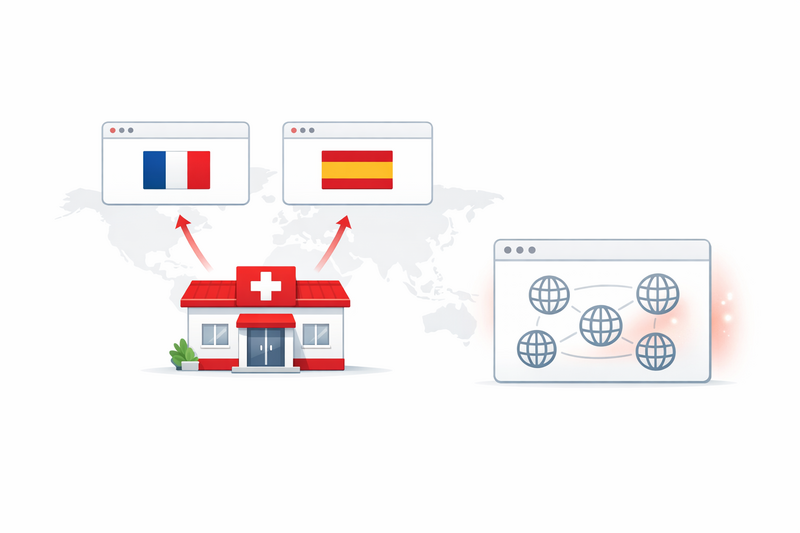
This is the core idea of an international layer: keep the clinic website focused on local needs, while maintaining a multilingual presence that can serve foreign patients reliably.
Rethinking international visibility without rebuilding the website
For many small practices, the question is not whether international visibility matters. It is how to achieve it without turning the clinic website into a complex, costly project. A practical approach is to separate the two goals:
- Local website: stable, simple, and focused on local patients.
- International layer: multilingual presence designed for foreign patients, with professional translation and easy updates.
This separation reduces dependency on agencies, lowers long-term maintenance friction, and protects quality in medical communication. As cross-border healthcare becomes more common and patient discovery behavior continues to evolve, clinics that build a reliable international layer can expand reach without rebuilding the foundation they already rely on.


